
The airline pilot career pathway is a structured sequence of FAA certifications, flight hour accumulation, and regulatory milestones that culminates in the Airline Transport Pilot (ATP) certificate required for airline employment. Every step builds directly on the last. You cannot skip the Private Pilot Certificate to get to a commercial job, and you cannot sit an ATP checkride without first completing the mandatory ATP Certification Training Program (ATP-CTP). Understanding the full sequence before you start saves you months of confusion and thousands of dollars in missteps.
The recognized industry term for this process is the "pilot certification pathway," and it follows a specific sequence governed by Title 14 of the Code of Federal Regulations (14 CFR). The FAA issues certificates in a defined order: Student Pilot, Private Pilot Certificate (PPL), Instrument Rating, Commercial Pilot Certificate (CPL), Certified Flight Instructor (CFI), Multi-Engine Rating, and finally the ATP certificate. Airlines operating under FAA Part 121 (scheduled air carriers) require the ATP as a minimum qualification for any pilot in command role. The pathway is not a suggestion. It is federal law.
Most pilots reach the airline cockpit in seven to ten years, though timelines vary significantly based on training access, R-ATP eligibility, and the hiring market. Knowing the full map before you start lets you make smarter decisions at every fork.
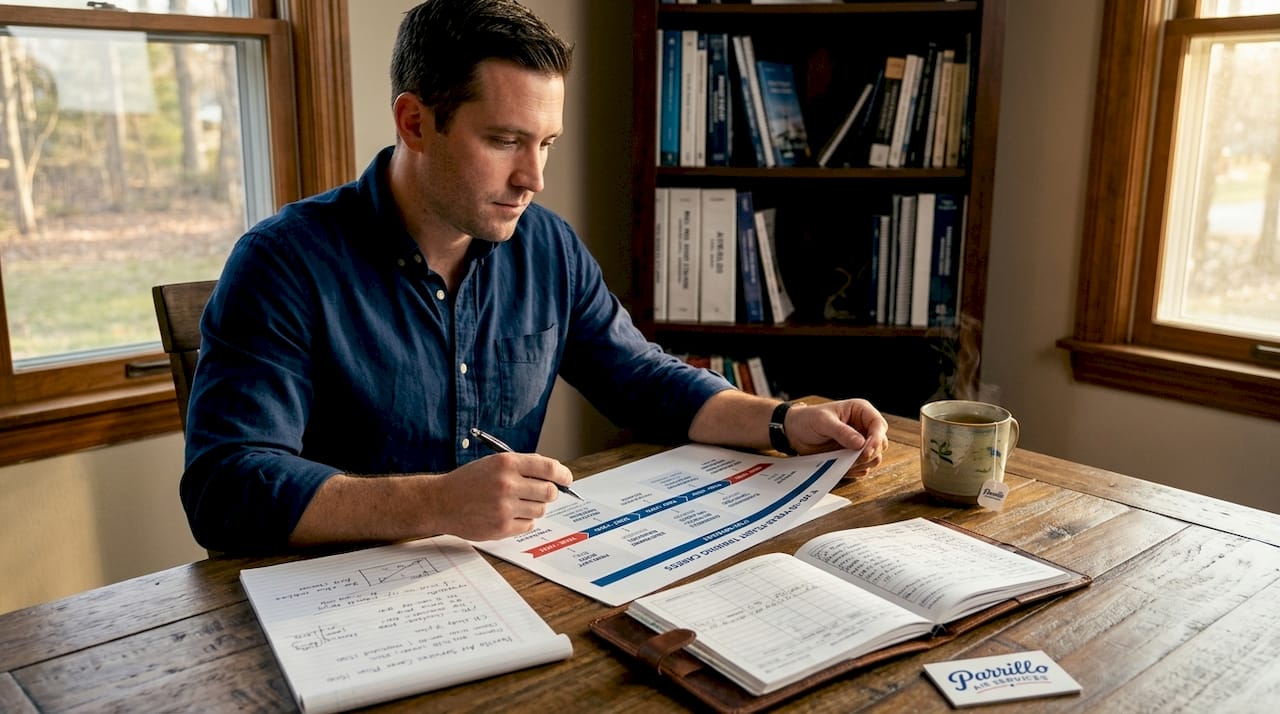
The Private Pilot Certificate (PPL) is the legal foundation of every aviation career. Without it, you cannot log pilot-in-command (PIC) time, which is a currency you will spend for the rest of your career. FAA Part 61 requires a minimum of 40 flight hours, including 20 hours of flight training and 10 hours of solo flight. In practice, most students finish closer to 60 to 70 hours before passing the checkride.
To get started, you will need an FAA Student Pilot Certificate before your first solo flight. Choose a flight school with structured syllabi and experienced instructors. Parrillo Air Services, based in Lynchburg, VA, offers Part 61 instruction with personalized scheduling that fits around work and family commitments.
Pro Tip: Log every flight meticulously from your very first lesson. Logbook accuracy becomes critical when airlines audit your hours before a conditional job offer.
The Instrument Rating (IR) allows you to fly in low-visibility conditions under Instrument Flight Rules (IFR). Airlines operate in all weather, so this rating is non-negotiable. The FAA requires 50 hours of cross-country PIC time and 40 hours of actual or simulated instrument time to qualify. After the IR, you pursue the Commercial Pilot Certificate, which legally authorizes you to fly for compensation. The CPL requires 250 total flight hours under Part 61, including specific cross-country, night, and instrument sub-requirements.
These two ratings together form the core of your professional pilot credential stack. Most pilots complete both within their first two years of training.
Airlines fly multi-engine turbine aircraft. A Multi-Engine Rating demonstrates you can manage the aerodynamics and systems of aircraft with more than one powerplant. It is typically added to your Commercial certificate and requires no minimum flight hours, only a practical test demonstrating proficiency.
The Certified Flight Instructor (CFI) certificate is the most strategically valuable rating you can earn at this stage. Becoming a flight instructor is the most common and cost-effective method of building the hours you need for airline hiring. Flight instructors build between 800 and 1,200 hours per year, making CFI jobs the fastest legal route to the 1,500-hour ATP minimum. You get paid to fly, and every hour counts toward your total time.
Pro Tip: Add the Certified Flight Instructor Instrument (CFII) rating alongside your CFI. It expands your student pool and lets you log additional instrument instruction time.
The FAA requires a minimum of 1,500 flight hours and age 23 for an unrestricted ATP certificate for scheduled Part 121 operations. That number is not just total time. The FAA breaks it into specific sub-buckets under 14 CFR §61.159: 500 hours of cross-country time, 100 hours of night time, 75 hours of instrument time, and 250 hours of PIC time, among others.
Here is how pilots typically build hours across the three most common routes:
Flight instruction: Earn your CFI and CFII, then instruct at a flight school. You build 800 to 1,200 hours per year while earning income.
Regional First Officer: Some pilots qualify for regional airline First Officer positions under a Restricted ATP (R-ATP) at 1,000 hours with an aviation degree or 1,250 hours with military experience. Regional FO flying accrues significant PIC and cross-country time toward full ATP requirements.
Charter and Part 135 operations: Flying cargo or charter builds diverse experience in varied conditions and aircraft types.
| Hour-building route | Typical annual hours | Cost or income |
|---|---|---|
| Flight instructor (CFI/CFII) | 800 to 1,200 | Paid employment |
| Regional First Officer (R-ATP) | 700 to 900 | Paid employment |
| Charter/Part 135 flying | 400 to 700 | Paid employment |
| Tuition-based hour building | 200 to 400 | Out-of-pocket cost |
Pro Tip: Track every sub-category of flight time in a digital logbook like ForeFlight or LogTen Pro from day one. Discovering a shortfall in cross-country or night hours at the 1,400-hour mark creates costly delays.
Accelerated pathways also exist. FAA-approved programs like the Coe College accelerated route allow R-ATP eligibility with as few as 1,000 hours at age 21 for qualified aviation degree graduates. If you are considering a four-year aviation degree, research whether your school holds FAA authorization for the R-ATP pathway before enrolling. The college degree question matters more than most new pilots realize.
The ATP Certification Training Program (ATP-CTP) is a mandatory 30-hour course that must be completed before you can sit the ATP knowledge (written) test. It is not optional exam prep. The FAA designed it to standardize pilot knowledge and readiness across the industry. The curriculum covers crew resource management (CRM), advanced aerodynamics, meteorology, air carrier operations, and simulator-based training scenarios.
ATP-CTP must be delivered by an FAA-approved Part 142 or Part 121 training center. Providers include FlightSafety International, CAE, and SIMCOM Aviation Training. Costs typically range from $5,000 to $8,000. The ATP written exam, once passed, is valid for 60 months.
Pro Tip: Time your ATP-CTP completion to coincide with your final hour-building phase. Many pilots complete it at 1,400 hours so they are ready to test and apply immediately upon reaching 1,500.
The ATP practical checkride is the final certification hurdle. Most pilots complete it during new-hire training at a regional airline, where the airline sponsors a type rating in the aircraft you will fly. ATP checkrides at regional airlines reduce upfront costs significantly since the airline absorbs the type rating expense. You must arrive with your ATP written exam already passed and your logbook hours verified.
The FAA First-Class medical certificate is equally critical and often underestimated. Airlines require a current First-Class medical for all flight operations. Key facts:
"Pilots often strategically schedule training milestones and medical exams to maximize remaining First-Class medical validity, especially around age 40 where validity periods shorten to six months." — FAA medical guidance
Pro Tip: Schedule your First-Class medical exam with an FAA Aviation Medical Examiner (AME) before you begin ATP-CTP. Discovering a disqualifying condition after investing in training is a preventable setback.
Airline hiring follows a defined documentation and interview process. United Airlines requires First Officer applicants to hold an unrestricted FAA ATP certificate, a multiengine rating, a current First-Class medical, and an FCC Radiotelephone Operator Permit, with a minimum of 1,500 total flight hours. Starting pay for new First Officers at United in 2026 is reported at $125.52 per flight hour. That figure reflects the industry standard for major airline entry-level compensation.
Regional airlines have lower minimums and serve as the primary entry point for most new airline pilots. Review regional airline hiring requirements carefully before applying, as each carrier sets its own preferred qualifications above the FAA minimums.
The hiring process typically includes:
Seniority governs everything at an airline: schedule, aircraft type, base, and pay. Your hire date is your most valuable career asset once you are inside the door.
The airline pilot career pathway requires sequential FAA certifications, strategic hour building, ATP-CTP completion, and thorough documentation before airline hiring becomes possible.
| Point | Details |
|---|---|
| Sequential certifications required | PPL, Instrument Rating, CPL, CFI, Multi-Engine, and ATP must be earned in order. |
| 1,500 hours with sub-requirements | FAA §61.159 mandates specific cross-country, night, PIC, and instrument hour buckets. |
| ATP-CTP is mandatory | The 30-hour course at a Part 142 provider must precede the ATP written exam. |
| First-Class medical timing matters | Validity shortens to six months after age 40; schedule exams around career milestones. |
| Documentation wins interviews | ATP certificate, First-Class medical, and FCC permit must all be current at application. |
Most people start pilot training thinking about the first step. The pilots who reach the airlines fastest think about the last step first and work backward. I have watched students spend months rebuilding logbook records because they did not track sub-categories from the beginning. I have seen others delay ATP-CTP because they did not realize it had to be completed at an approved Part 142 center, not just any flight school.
The medical certificate is the piece most people ignore until it becomes a crisis. If you are over 35, get your First-Class medical before you invest another dollar in training. An undisclosed condition or a medication conflict can ground a career before it starts. The FAA's CACI (Conditions AMEs Can Issue) program has expanded significantly, but you need to know your status early.
My strongest advice: choose a flight school that understands the full pathway, not just the certificate in front of you. A good instructor at the PPL stage should already be talking to you about instrument training, commercial requirements, and CFI strategy. If they are not, you are getting half the education you are paying for.
— Gm

Parrillo Air Services in Lynchburg, VA offers FAA Part 61 flight training designed for pilots who are serious about reaching the airlines. From your first discovery flight through Private Pilot, Instrument, Commercial, and CFI certifications, every program is built around personalized instruction, flexible scheduling, and real-world preparation for airline hiring standards. The instructors at Parrillo Air Services understand the full career pathway and train you with the ATP certificate as the destination, not an afterthought. If you are ready to take the first step or the next one, request more information about training programs or visit Parrillo Air Services to schedule your discovery flight today.
The FAA requires a minimum of 1,500 total flight hours for an unrestricted ATP certificate under Part 121 operations. Pilots with qualifying aviation degrees or military experience may qualify for a Restricted ATP at 1,000 to 1,250 hours.
The ATP-CTP is a mandatory 30-hour training course that must be completed at an FAA-approved Part 142 or Part 121 training center before a pilot can take the ATP knowledge test. It covers crew resource management, advanced aerodynamics, and air carrier operations.
Most pilots reach a regional airline in four to six years and a major airline within seven to ten years, depending on training pace, R-ATP eligibility, and market conditions. Flight instructors who build 800 to 1,200 hours per year move through the timeline fastest.
Major airlines strongly prefer a four-year degree, and some R-ATP pathways require an aviation degree to reduce the hour minimums. A qualifying degree from an FAA-authorized program can lower your ATP hour requirement from 1,500 to 1,000.
Airline pilots must hold a current FAA First-Class medical certificate, which is valid for 12 months under age 40 and six months at age 40 or older. The certificate must remain current through all flight operations and airline employment.